
Saturday, August 15, 2015

Thursday, August 13, 2015
Cokundiawthah Mohawk War Chief
After Harmar;s defeat (Fort Wayne Indiana) and loss of Mohawk War Chief, and husband of Cooh-coo-cheeh with his family, consisting of his wife, three sons, and a daughter, had removed from the St. Lawrence and settled at the Shawnee village a mile below the mouth of the Auglaize River. In the victory of the Indians over a part of the army of Harmar under Hardin and Wyllys, in October, 1790, in a furious charge made against the regulars, while in the act of tomahawking a soldier he received a mortal wound from a bayonet, and dying on his way home was buried on the bank of the Maumee river about twenty miles from the battle ground.
The Indian Captivity Of O.M. Spencer Page 82-83-84

Wednesday, August 12, 2015
Civil Story Defiance County History (1976) Page 488


A company of Union soldiers (124th OVI CoD) were in camp in the south, I believe it was in Georgia. It was terribly hot and dry, and hardly any available water near by. The men were near to dehydration; they were really suffering for lack of water. Finally someone proposed that they would form a circle and would pray for water. Furthermore, they vowed to keep on praying even if they died doing it. In fact, several did die. However, they kept on praying for quite some time, when suddenly a spring of water bubbled up in the center of the circle! How they rejoiced, and drank, and thanked GOD! A miracle! Pvt. Frederick Martch (124th O.V.I Co. D) To his Grandson Blake Myers
Tuesday, August 11, 2015
A Strange Case Defiance Democrat 19 Jan 1893

W.P Wilson was a farmer living in Delaware township. He has been married twice, the second time to Ella Thomas, daughter of John Thomas of the same township.
Wilson's mother was a widow, and before Wilson's marriage with Etta Thomas her father had married Wilson's mother.
Wilson's mother died and Thomas married Wilson's aunt, Lucinda Kibble.
Wilson's aunt being Thomas' wife, is now not only Wilson's aunt, but also his mother-in-law. To Wilson's wife she is aunt by marriage and stepmother.
Thomas is Wilson's father-in-law, step-father and uncle by marriage.
Wilson is the father of several children and person so disposed can figure out what relation they are to the other branches of the family.
Wilson's case is an interesting one and he is at a loss to know what relation he is to himself. He came to this office and told us his story as given in this article.
Jonathan Chapman " AKA Johnny Appleseed" Repesentative Citizens Of Paulding County 1902 Page 39-41
"He lived for others solely, so far as I remember him,denying himself all the comforts of life, unless it was the comfort of knowing that he was doing great and lasting good. He seemed proof against peril and empowered with ubiquity. The Indians considered him crazy, fed and warmed him, but never molested him as he traveled through their lands and up down streams; I may not be able to relate much that is new or old in regards to Johnny. When I was quite young, four or five years old. I remember he stayed at my father's house (Isaac Carey), clothed in rags, and shoes bound on his feet by strings to hold them on his feet and the piece of shoes from parting company.
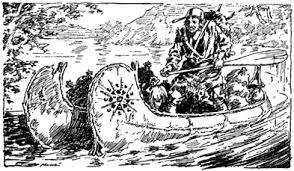 He seemed as happy as a lark, and I might as well say here that he was full of exhortation and good words, a good supply of religious tracts that he distributed with a liberal hand in every cabin where they could read. Johnny was a follower and believer in Emanuel Swedenborg, and a member of the New Jerusalem church. Johnny, I remember, was not a believer in fire and brimstone combined and burning forever; for he said that he though that the worst part of hell would not be worse than smokey house and scolding women.But Johnny was a bachelor, and that may account for a part of that fling at the scolding women. My father, on one occasion, ask Johnny why he never married; he turned the subject by saying that in the world to come he should have a wife. He would not wear good clothes. My father at one time made him a present of a pair of shoes about as good as new, expecting he would put them on ; but no; he packed them in his bundle of valuable and packed them on,saying they were too good to wear, but they would make a fine present for some needy person. Johnny not only peddled apple seeds, but catnip, pennyroyal and hoarhound, and in that way these streams in the early day had these useful herbs. Johnny, if crazy, and I do not think he was, knew where to place his nurseries at the head of streams, and then, with a canoe loaded with apple trees, float down stream with a light pot or a tin pail on his head, stopping at the cabins and giving out seeds and selling, or pretending to sell, trees, as I think he but seldom, if ever, got much value for the same."
Judge David Carey 1891
| Isaac Carey's cabin, Paulding County,Ohio |
Saturday, August 8, 2015


Wednesday, August 5, 2015
Last Of The Pioneers Of Defiance Daily Crescent News 4-10-1910
 Reason Wells was born in the city of Zanesville, Ohio, May 22 1821, and while a mere boy, his father removed with his family to Defiance in 1832, believing, as did many another at the time, that the completion the Miami and Erie Canal, then being agitated in the General Assembly, would cause the wilderness just beyond the Black Swamp to brighten and bloom and prove a region of exceeding richness and that Defiance, the town located at the junction of the Maumee and Auglaize Rivers. Which at this early day was the only town in the valley of the "Miami of the Lake," between Perrysburg and Maumee City and the city of Fort Wayne, Ind.
At the time of the arrival of the Wells family in Defiance the town was located in Auglaize township, in Williams county, Ohio, Defiance county not being organized for a number of years after. In the entire township at this time there were but fifty-seven taxpayers and of this number thirty-five lived in the village of Defiance all of whom are long since dead.
At this time the entire tract of land on which now stands the Harley&Whitaker (122-124 Clinton street) store, extending from First street to the river (Maumee) and from Clinton street west as far as Perry street, was a large orchard and in the center of the plot was an old tumble down log house said to be haunted. Mr. Wells told the writer of this that when he came to Defiance the business of the town was all done on Jefferson street and the first store he remembered was one kept by Isaac Hull, on the north east corner of Front and Jefferson. He afterwards sold it to a man by the name of Benjamin Brubaker. A part of this old store building was used in the residence of Lake Erie Myers. On the corner of Front and Jefferson, the northwest corner, on the river side of Front street, was a building, in which a man by the name of Kirk kept store and in the basement, fronting the river, was a grocery kept by Edwin Phelps and William A Brown. On the opposite corner, the south-west corner, was a hotel kept by a Mr. Waterhouse and it was called "The Waterhouse," afterward "The Washington" and still later, "The Pavillion." Next to this hotel on the south was Foreman Evans, Evans store, and next south Amos Evans store and on the corner, where now stands Richard Sutphen's home,(cor. First and Jefferson) a man by the name of John R Wilson kept a tailor shop, on the opposite corner where now stands the Shelly home (202 Jefferson) which was built by Dave Oliver a large two story frame building for William Seamans to be used as a printing office. Next south of the printing office was Dr. John Evans home and office, and in this same building John Kiser, the grandfather of Mollie Daoust; was married to John Downs' daughter. Two germans Hoffrichter and Ort had a bakery next.
Diagonally across the street lived old Peter Bridenbaugh and on the corner where now lives Charles Behringer (301 Third street) lived a man by the name of Walter Davis, the first fiddler I ever saw. In 1832 and until 1840 a man by the name of Straight ran a ferry from the foot of Jefferson street and in 1840 a man by the name of Tower built the first bridge across the Maumee at Clinton street; it was a toll bridge and Adam Wilhelm was the first toll keeper. Between 1836 and 1840 new stores were opened one by the Case brothers on the southeast corner of Wayne and Front streets; next east of this store came Francis Weisenberger, with a grocery and bakery, next east came John Kniss with his residence and shoe shop, about where Wesley Rout (415 Front street) now lives; almost directly across from the Kniss building was a blacksmith shop run by a man by the name of Beerup.
In 1836 occurred the greatest flood (1910) Defiance ever experienced the water was so high the traders and Indians tied their pirogues and canoes to the trees of Clinton street where now stands the Harley and Whitaker store (corner of First and Clinton streets). This same spring Defiance experienced its hardest times and the father of Mr. Wells and a man by the name of Mason started for Maumee, the nearest grist mill to buy some corn and flour. They went in a pirogue and were gone six weeks returning with a few bushels of corn which they paid $2.50 per bushel and barrel of flour, all they could get for which they paid $16.50.
Johnny cakes, bran pones, and hominy, with mush and milk for side dishes, and for constituted the diet for all, rich and poor alike, and now and then some fried mush, fried on boards, or flat stones, for we did not have stoves when he came to Defiance. It was a wealthy family that could boast of a "Dutch Oven" a frying pan or "spider," for these comprised about all the kitchen and cooking utensils. The cooking was done in the fireplace and the owner could afford it an iron crane was attached to the side of the fireplace and arranged to swing out to hang on the kettle and swing back over the fire, but when this could not be afforded forked sticks were stuck up one at each end of the fire place and in the forks was laid another stick and on this the pots and kettles would be hung over the fire.
Horse racing, running and jumping, wrestling pitching horse shoes, shooting at mark,driving the nail and snuffing the candle were the sports of the men and boys and dancing that of both sexes. We though nothing of walking six to ten miles and even further to attend a wedding or a dance, a frolic, we used to call it.
At this time the entire tract of land on which now stands the Harley&Whitaker (122-124 Clinton street) store, extending from First street to the river (Maumee) and from Clinton street west as far as Perry street, was a large orchard and in the center of the plot was an old tumble down log house said to be haunted. Mr. Wells told the writer of this that when he came to Defiance the business of the town was all done on Jefferson street and the first store he remembered was one kept by Isaac Hull, on the north east corner of Front and Jefferson. He afterwards sold it to a man by the name of Benjamin Brubaker. A part of this old store building was used in the residence of Lake Erie Myers. On the corner of Front and Jefferson, the northwest corner, on the river side of Front street, was a building, in which a man by the name of Kirk kept store and in the basement, fronting the river, was a grocery kept by Edwin Phelps and William A Brown. On the opposite corner, the south-west corner, was a hotel kept by a Mr. Waterhouse and it was called "The Waterhouse," afterward "The Washington" and still later, "The Pavillion." Next to this hotel on the south was Foreman Evans, Evans store, and next south Amos Evans store and on the corner, where now stands Richard Sutphen's home,(cor. First and Jefferson) a man by the name of John R Wilson kept a tailor shop, on the opposite corner where now stands the Shelly home (202 Jefferson) which was built by Dave Oliver a large two story frame building for William Seamans to be used as a printing office. Next south of the printing office was Dr. John Evans home and office, and in this same building John Kiser, the grandfather of Mollie Daoust; was married to John Downs' daughter. Two germans Hoffrichter and Ort had a bakery next.
Diagonally across the street lived old Peter Bridenbaugh and on the corner where now lives Charles Behringer (301 Third street) lived a man by the name of Walter Davis, the first fiddler I ever saw. In 1832 and until 1840 a man by the name of Straight ran a ferry from the foot of Jefferson street and in 1840 a man by the name of Tower built the first bridge across the Maumee at Clinton street; it was a toll bridge and Adam Wilhelm was the first toll keeper. Between 1836 and 1840 new stores were opened one by the Case brothers on the southeast corner of Wayne and Front streets; next east of this store came Francis Weisenberger, with a grocery and bakery, next east came John Kniss with his residence and shoe shop, about where Wesley Rout (415 Front street) now lives; almost directly across from the Kniss building was a blacksmith shop run by a man by the name of Beerup.
In 1836 occurred the greatest flood (1910) Defiance ever experienced the water was so high the traders and Indians tied their pirogues and canoes to the trees of Clinton street where now stands the Harley and Whitaker store (corner of First and Clinton streets). This same spring Defiance experienced its hardest times and the father of Mr. Wells and a man by the name of Mason started for Maumee, the nearest grist mill to buy some corn and flour. They went in a pirogue and were gone six weeks returning with a few bushels of corn which they paid $2.50 per bushel and barrel of flour, all they could get for which they paid $16.50.
Johnny cakes, bran pones, and hominy, with mush and milk for side dishes, and for constituted the diet for all, rich and poor alike, and now and then some fried mush, fried on boards, or flat stones, for we did not have stoves when he came to Defiance. It was a wealthy family that could boast of a "Dutch Oven" a frying pan or "spider," for these comprised about all the kitchen and cooking utensils. The cooking was done in the fireplace and the owner could afford it an iron crane was attached to the side of the fireplace and arranged to swing out to hang on the kettle and swing back over the fire, but when this could not be afforded forked sticks were stuck up one at each end of the fire place and in the forks was laid another stick and on this the pots and kettles would be hung over the fire.
Horse racing, running and jumping, wrestling pitching horse shoes, shooting at mark,driving the nail and snuffing the candle were the sports of the men and boys and dancing that of both sexes. We though nothing of walking six to ten miles and even further to attend a wedding or a dance, a frolic, we used to call it.
Subscribe to:
Posts (Atom)